

Air Starter Market Projected to Reach USD 726.50 Million by 2035, Growing at 5.02% CAGR
Air Starter Market
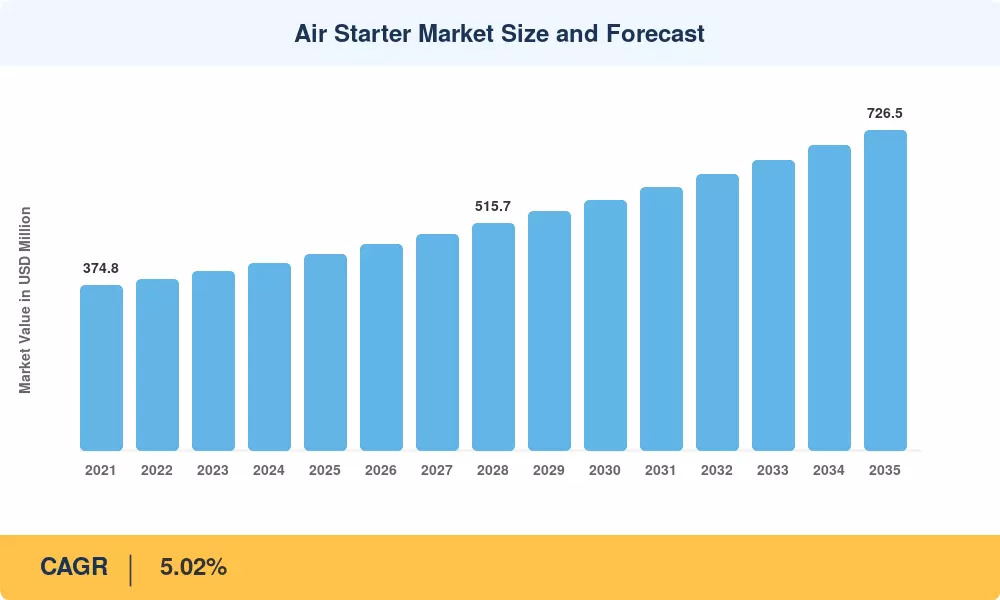
Air Starter Market is projected to grow from USD 467.70 Million in 2026 to USD 726.50 Million by 2035, CAGR of 5.02% across the forecast 2026 to 2035
As Per the MRFR Analysis, Air Starter Market is projected to grow from USD 467.70 Million in 2026 to USD 726.50 Million by 2035, registering a CAGR of 5.02% across the forecast 2026 to 2035”
NEW YORK, NY, UNITED STATES, August 24, 2026 /EINPresswire.com/ -- As Per the MRFR Analysis, Air Starter Market is projected to grow from USD 467.70 Million in 2026 to USD 726.50 Million by 2035, registering a CAGR of 5.02% across the forecast 2026 to 2035, driven by Integration of advanced automation technologies.— Prashant Hake
Market Overview
The Air Starter Market encompasses pneumatic starting systems designed to initiate the operation of internal combustion engines and gas turbines in environments where electrical spark risks are unacceptable. These systems use compressed air to crank engines, offering a safe, reliable alternative to electric starters in hazardous areas such as oil and gas facilities, mining operations, marine vessels, and power generation plants. Air starters are critical components in upstream drilling, LNG bunkering, autonomous mining fleets, and emergency backup systems, providing ignition-free starting capability that meets stringent ATEX and IECEx certification requirements.
Persistent demand from hazardous-environment industries—particularly upstream oil and gas operations and LNG-fueled marine fleets—continues to anchor spending on pneumatic starting systems that eliminate electrical spark risks. Tighter ATEX and IECEx certification mandates issued between 2023 and 2025 have compelled operators in Zone 1 and Zone 2 classified areas to upgrade legacy electric starters, channeling fresh capital into compliant air-driven alternatives [1][2]. Compliance audits in 14 EU member states between Q3 2023 and Q4 2024 led to orders for starter equipment totaling about USD 62 million, underscoring the regulatory-driven nature of market demand [2].
A technological shift is reshaping the competitive landscape of the Air Starter Market. Traditional vane-type systems, long the workhorse of the market, are being supplemented by gear-reduced hybrid units that deliver higher torque density at lower air consumption. Ingersoll Rand's 2024 capital allocation of USD 38 million toward next-generation starter R&D signals the scale of investment flowing into these designs [3]. Meanwhile, predictive-analytics platforms now integrate with aftermarket starter hardware, enabling fleet operators to schedule maintenance windows around compressor availability rather than reactive breakdowns [9]. The integration of advanced automation technologies, including IoT sensors, CAN-bus integration, and remote start protocols, is enabling autonomous cold-start sequences without human presence in mining and offshore applications [6][20].
Get Free Sample Report for Detailed Market Insights:
https://www.marketresearchfuture.com/sample_request/33656
Market Segmentation
By Starter Type
The Air Starter Market is segmented into Vane Air Starters, Turbine Air Starters, and Gear-Reduced Air Starters. Vane air starters accounted for approximately 49.70% of market revenue in 2025, reflecting their dominance in sub-100 HP engine categories across oil-field and marine auxiliary applications [2]. Their simple rotor-and-vane mechanism tolerates harsh environments with minimal maintenance, making them the default choice for wellsite generators, marine auxiliary diesels, and compressor packages across upstream oil and gas operations.
Turbine air starters represent a significant segment at USD 98.40 million in 2025, serving large-displacement gas turbines in power generation applications where high-speed cranking is essential. Gear-reduced air starters are projected to register a CAGR of 7.10% through 2035, propelled by demand from larger-displacement engines in mining haul trucks and power-generation turbines [6]. Mining haul trucks with 2,000+ HP engines and large marine propulsion diesels increasingly specify these units because the gear train multiplies cranking torque without requiring proportionally larger air receivers.
By Engine Capacity
The Air Starter Market serves Up to 100 HP, 100 to 300 HP, and Above 300 HP engine capacity classes. The up-to-100 HP class accounts for the vast majority of the market at 79.90% share by unit volume, covering everything from wellhead compressor packages and emergency generators to shipboard fire-pump engines [12]. These starters are commoditized in mature markets, where aftermarket replacement sales now outpace new OEM installations by roughly 1.4 to 1.
The 100-to-300 HP segment is the fastest-growing engine class with a 5.30% CAGR, reflecting a shift toward mid-range gensets in distributed power applications and LNG-fueled coastal vessels. End users in this segment value the torque-to-weight ratio that pneumatic systems offer over similarly rated electric starters, particularly in Zone 1 environments. The above 300 HP segment, valued at USD 24.60 million in 2025, serves heavy-duty mining trucks and main propulsion engines where high torque output is critical.
By End-User
The Air Starter Market serves Oil and Gas, Power Generation, Mining, Marine, Aviation, and Transportation end-users. The oil and gas sector commanded roughly 39.20% of the market share in 2025, sustained by brownfield retrofit programs and ATEX compliance upgrades [1][2]. Upstream operators in the Permian Basin, North Sea, and Middle East specify pneumatic starters as non-negotiable safety equipment, and midstream compressor stations on transcontinental pipelines add incremental demand each time a new lateral is commissioned.
Mining end users are anticipated to expand at a 5.75% CAGR through 2035 as autonomous fleet rollouts require low-maintenance starting systems [6]. Major mining houses—including Rio Tinto, BHP, and Fortescue—are scaling autonomous haul-truck fleets that favor low-maintenance, fail-safe starting solutions. Marine applications account for USD 53.70 million in 2025, buoyed by LNG dual-fuel vessel construction, while aviation (ground-support turbine starting) and transportation (rail and heavy-duty vehicle auxiliary) represent smaller but strategically important segments [4][23].
By Region
North America led the Air Starter Market with a 36.70% revenue share in 2025, driven by Permian Basin drilling and Gulf Coast refinery maintenance cycles. Europe captured the second-largest share at approximately 26.30%, supported by North Sea decommissioning-and-recommissioning activity and stringent EU ATEX enforcement. Asia-Pacific is forecast to grow at a 7.25% CAGR, the quickest of any region, fueled by LNG bunkering mandates and coal-to-gas power transitions. South America and the Middle East & Africa contribute smaller shares at USD 30.30 million and USD 25.40 million respectively, driven by pre-salt offshore operations and legacy field upgrades.
You can buy this market report at:
https://www.marketresearchfuture.com/checkout?currency=one_user-USD&report_id=33656
Regional Analysis
North America
North America holds the largest share of the Air Starter Market at approximately 36.70% of global revenue, underpinned by the Permian Basin's sustained drilling intensity and a mature retrofit cycle across Gulf Coast refining complexes. The United States dominates with 71.50% of regional share, with Permian Basin operators alone accounting for over 2,800 active starter-equipped engines as of year-end 2024 [2]. The U.S. Bureau of Safety and Environmental Enforcement (BSEE) issued 847 inspection notices in 2024 citing non-compliant ignition systems on offshore platforms, translating into an addressable retrofit opportunity estimated at USD 28 million in starter hardware [2]. Canada follows with 18.20% of regional share, supported by oil sands operations and Shell-led LNG Canada commissioning in Kitimat, British Columbia, which specified pneumatic starting across all gas-turbine compressor trains [17].
Europe
Europe holds the second-largest share of the Air Starter Market at approximately 26.30%, supported by North Sea decommissioning-and-recommissioning activity and stringent EU ATEX Directive 2014/34/EU enforcement. The UK accounts for 22.80% of regional share, with the North Sea Transition Authority approving 31 field-life extensions between 2023 and 2025, each triggering mandatory safety-system upgrades that include starter replacements [8]. Germany follows with a 5.48% CAGR, driven by industrial turbine installations and hydrogen pilots, including the Leipheim hydrogen-ready turbine pilot backed by EUR 120 million in federal funding [7]. France and Italy contribute through nuclear auxiliary diesel standby systems and Adriatic offshore gas development respectively, while Nordic countries focus on Arctic offshore and maritime compliance.
Asia-Pacific
Asia-Pacific is the fastest-growing region in the Air Starter Market, forecast to expand at a 7.25% CAGR through 2035, driven by LNG bunkering infrastructure buildouts and coal-to-gas power transitions. China leads with 34.60% of regional share, with the Ministry of Transport designating 19 coastal ports as priority LNG bunkering hubs under its 14th Five-Year Plan [4]. South Korea accounts for 15.20% of regional share, with Hyundai Heavy Industries and Samsung Heavy Industries launching 54 LNG-fueled newbuild orders in 2024, each specifying dual air-start systems per main engine [18]. India follows with a 6.85% CAGR, driven by refinery expansion and defense diesel fleet requirements, while Japan contributes through hydrogen co-firing turbine installations [7].
Rest of the World
South America and the Middle East & Africa represent smaller but strategically important segments of the Air Starter Market. Brazil dominates South American demand with 68.30% of regional share, driven by pre-salt deepwater FPSO deployments. Petrobras plans to deploy eight additional FPSOs between 2026 and 2030 in the Santos and Campos basins, with each vessel carrying 14–18 air-started diesel generator sets [16]. Saudi Arabia leads the MEA region with 33.50% of regional share, with Aramco's USD 12.4 billion Jafurah unconventional gas development deploying over 400 air-started compressors and pump-drive engines [19]. Egypt's Zohr and Raven gas fields continue to expand compression capacity, sustaining a steady stream of starter orders from Mediterranean offshore operators.
Competitive Landscape / Key Players
The Air Starter Market exhibits medium concentration, with the top five players accounting for an estimated 52–58% of global revenue [14]. Key players include Ingersoll Rand, TDI (Tech Development Inc.), IPU Group, Gali International, Voith Group, Parker Hannifin, Honeywell, Atlas Copco, Hilliard Corporation, and Maradyne Corporation [14].
Ingersoll Rand leads with an estimated 14–18% revenue share, offering SS and ST series vane starters and turbine starters with the broadest portfolio and global distribution [3]. TDI follows with 10–14% share, specializing in GPS series turbine starters for large engines as a high-torque heavy-industrial specialist. IPU Group holds 7–10% share, providing Jenbacher-compatible vane and turbine starters as a European aftermarket leader. Gali International commands 5–8% share, focusing on vane and gear-reduced starters for marine and mining with a Mediterranean and APAC focus. Voith Group holds 4–7% share, offering integrated drivetrain and starting solutions with cross-selling into turbo-coupling customers [14].
Strategic developments in the industry include TDI's November 2024 securing of a USD 22 million multi-year supply contract with Petrobras for GPS-series turbine starters across eight new FPSO units in the Santos Basin [16]. IPU Group opened a regional service center in Singapore in August 2024 to support Asia-Pacific market growth, offering 48-hour turnaround on vane-cartridge overhauls [18]. Gali International introduced a gear-reduced starter designed for autonomous mining trucks in May 2024, featuring IP68 dust-and-moisture protection and CAN-bus integration for remote cold-start capability [6].
Latest Industry News & Developments
TDI (November 2024): Secured a USD 22 million multi-year supply contract with Petrobras for GPS-series turbine starters across eight new FPSO units in the Santos Basin [16].
IPU Group (August 2024): Opened a regional service center in Singapore to support Asia-Pacific market growth, offering 48-hour turnaround on vane-cartridge overhauls [18].
Gali International (May 2024): Introduced a gear-reduced starter designed for autonomous mining trucks, featuring IP68 dust-and-moisture protection and CAN-bus integration for remote cold-start capability [6].
Atlas Copco (February 2024): Partnered with DNV to develop a compressed-air quality standard for marine starting systems, aiming to reduce moisture-related starter failures by 30% [10].
Parker Hannifin (October 2023): Acquired a minority stake in a Finnish IoT startup specializing in pneumatic-system condition monitoring, signaling a strategic move into predictive-maintenance-as-a-service for starters [9].
Market Challenges & Opportunities
Challenges
The Air Starter Market faces several notable challenges. Electric starter cost reductions represent a significant headwind, with explosion-proof electric starter enclosures from Parker Hannifin and Bosch offering IP67-rated solutions that are 18–22% less expensive than comparable pneumatic units for Zone 2 applications [11]. While pneumatic starters maintain an advantage in Zone 0 and Zone 1 conditions, the price gap narrows with each product cycle.
Compressed-air infrastructure costs pose another constraint, as end users must purchase compressors, receivers, and distribution piping to operate an air starter, requiring a consistent supply of compressed air at 90–150 psi [12]. This auxiliary infrastructure can increase the total cost of ownership by 30–40% in remote mining operations throughout Sub-Saharan Africa and Southeast Asian island locations. Electrification of mining fleets, with battery-electric haul trucks entering pilot phases at Boliden, Epiroc, and Caterpillar, threatens to shrink the addressable market for pneumatic starters over the long term [13]. Supply-chain delays for specialty vanes and limited standardization across OEMs further challenge market growth.
Opportunities
Significant opportunities exist in the Air Starter Market. Hydrogen-ready power plants present a greenfield opportunity, with governments in Germany, Japan, and Australia committing combined public funding exceeding USD 22 billion for hydrogen hub development through 2030 [7]. Hydrogen-fueled gas turbines require starter systems rated for higher ignition pressures and faster cranking speeds, creating demand for next-generation pneumatic starters capable of cranking at pressures above 200 psi [7][21].
Aftermarket predictive analytics platforms offer a shift from transactional spare-parts sales to recurring-revenue models, with service providers bundling IoT-enabled sensors with starter hardware to offer condition-based maintenance subscriptions [9]. This could expand aftermarket margins by 8–12 percentage points per unit installed. Emerging market upstream expansion in Guyana, Suriname, and Mozambique requires full greenfield installations of ATEX-certified starting equipment, with Guyana's Stabroek Block alone anticipating 10 FPSO deployments by 2030 [16]. The dual-fuel marine retrofit wave, with approximately 2,400 vessels flagged for conversion between 2026 and 2032, represents a significant mid-life retrofit opportunity for starter systems [10].
To explore more market insights, visit us at:
https://www.marketresearchfuture.com/reports/air-starter-market-33656
Final Market Summary
The Air Starter Market is poised for steady growth, projected to expand from USD 467.70 million in 2026 to USD 726.50 million by 2035, at a CAGR of 5.02%. This expansion is fundamentally underpinned by ATEX and IECEx compliance mandates, LNG bunkering fleet expansion, and autonomous mining fleet rollouts that create sustained demand for pneumatic starting systems. North America maintains its dominant position, while Asia-Pacific emerges as the fastest-growing region, driven by LNG bunkering infrastructure buildouts and coal-to-gas power transitions. Technological innovation, including gear-reduced starters, predictive-analytics platforms, and remote start protocols, is reshaping the competitive landscape, enabling operators to achieve higher torque density, reduced maintenance, and autonomous operation. The market's long-term potential remains strong, supported by the convergence of safety regulation, corporate automation commitments, and emerging opportunities in hydrogen-ready power plants and dual-fuel marine retrofits, ensuring air starters' continued critical role in hazardous-environment engine starting through 2035 and beyond.
More Related Reports from MRFR Library:
Portable Power Station Market: https://www.marketresearchfuture.com/reports/portable-power-station-market-10079
Green Hydrogen Market: https://www.marketresearchfuture.com/reports/green-hydrogen-market-10083
Horizontal Pumping Systems Market: https://www.marketresearchfuture.com/reports/horizontal-pumping-systems-market-10406
UPS Battery Market: https://www.marketresearchfuture.com/reports/ups-battery-market-10461
Power T&D Equipment Market: https://www.marketresearchfuture.com/reports/power-td-equipment-market-10689
Natural Gas Liquid Market: https://www.marketresearchfuture.com/reports/natural-gas-liquid-market-10887
Biogas Market: https://www.marketresearchfuture.com/reports/biogas-market-10925
Underground Natural Gas Storage Market: https://www.marketresearchfuture.com/reports/underground-natural-gas-storage-market-10944
Fuel Cell Market: https://www.marketresearchfuture.com/reports/fuel-cell-market-10961
Wave Energy Converter Market: https://www.marketresearchfuture.com/reports/wave-energy-converter-market-11049
Larry Wilson
WantStats Research And Media Pvt. Ltd.
+ +1 855-661-4441
email us here
Visit us on social media:
LinkedIn
Facebook
YouTube
X
Legal Disclaimer:
EIN Presswire provides this news content "as is" without warranty of any kind. We do not accept any responsibility or liability for the accuracy, content, images, videos, licenses, completeness, legality, or reliability of the information contained in this article. If you have any complaints or copyright issues related to this article, kindly contact the author above.
